Etymology of Godzilla
The name Godzilla is a transliteration of Gojira (ゴジラ), a combination of two Japanese words which means half gorilla, and half whale. : gorira (ゴリラ), and kujira (鯨(くじら). At one
8 min read
In the Japanese films, Godzilla is depicted as a gigantic prehistoric creature, and his first attacks on Japan are linked to the beginning of the Atomic Age. In particular, mutation due to atomic radiation is presented as an explanation for his great size and strange powers.
Godzilla’s iconic design is composed of a mixture of various species of dinosaurs; specifically, he has the body and overall shape of a Tyrannosaurus, the long arms of an Iguanodon, and the dorsal fins of a Stegosaurus.
Godzilla appeared from the sea, but looks like a terrestrial dinosaur. Through time and as more Godzilla films were released, his appearance changed to reflect the concerns of its time. Also his change in form corresponded to a change in character. In his latest incarnation, the dorsal fins are much bigger, sharper and more menacing. The colours also changed from white to purple, to match the skin colour which is now deep green.
The name Godzilla is a transliteration of Gojira (ゴジラ), a combination of two Japanese words which means half gorilla, and half whale. : gorira (ゴリラ), and kujira (鯨(くじら). At one
8 min read
Dreamed up by Eiji Tsuburaya in 1954, Godzilla is the answer to the atomic bomb. The earliest Godzilla films, especially the original Gojira, attempted to portray Godzilla as a frightening,
8 min read
In the late Cretaceous era (70 million years ago) there was a species of therapod dinosaur resembling a large Tyrannosaurus, but with special amphibious adaptations which allowed it to swim
8 min read
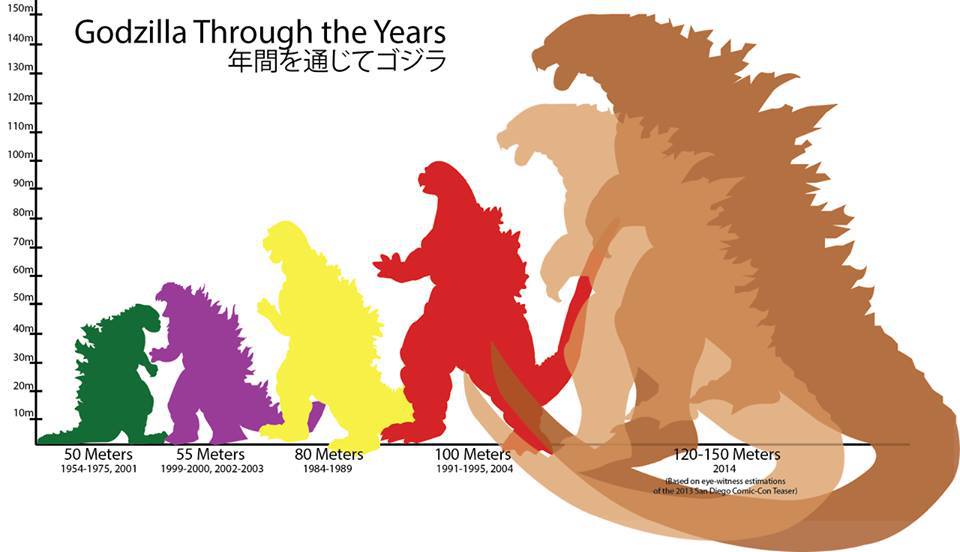
In the most recent release, Godzilla is a large, irradiated, reptilian dinosaur-like creature standing at 100 meters tall and about 200 meters long from snout to tail. He has a
8 min read