There are no nazi werewolves except in the scenari of some exploitation or B movies, however the nazis created at the end of WWII a special unit know as Werhwolf.
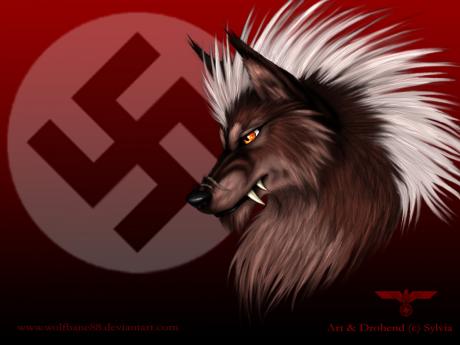
The name was chosen after the title of Hermann Löns’ novel, Der Wehrwolf (1910). Set in the Celle region, Lower Saxony, during the Thirty Years’ War (1618–48), the novel concerns a peasant, Harm Wulf, who after his family is killed by marauding soldiers, organises his neighbours into a militia who pursue the soldiers mercilessly and execute any they capture, referring to themselves as Wehrwölfe. While not himself a Nazi (he died in 1914) Löns’ work was also popular with the German far right, and the Nazis celebrated his work.
In late summer/early autumn 1944, Heinrich Himmler initiated Unternehmen Werwolf (Operation Werwolf), ordering SS Obergruppenführer Hans-Adolf Prützmann to begin organising an elite troop of volunteer forces to operate secretly behind enemy lines to undertake guerilla actions and sabotage.
Werwolf originally had about five thousand members recruited from the “SS” (Schutzstaffel) and the Hitler Youth (Hitler-Jugend). These recruits were specially trained in guerrilla tactics. Operation Werwolf went so far as to establish front companies to ensure continued fighting in those areas of Germany which were occupied (all of the “front companies” were discovered and shut down within eight months).
On March 23, 1945, Joseph Goebbels gave a speech, known as the Werwolf speech, in which he urged every German to fight to the death. The partial dismantling of the organised Werwolf, combined with the effects of the “Werwolf” speech, caused considerable confusion about which subsequent attacks were actually carried out by Werwolf members, as opposed to solo acts by fanatical Nazis or small groups of SS.
Some current German neo-Nazi groups refer to themselves as Werwolf or Wehrwolf, some of which use the Wolfsangel symbol (German for “wolf’s hook”) whose horizontal variant is known as “werewolf”
Rob Zombie’s Werewolf Women of the S.S. faux trailer for Grindhouse tells of a Nazi camp where fiendish experiments are being performed to create an army of werewolf soldiers. The usual assortment of Zombie performers star including wife Sheri Moon, Udo Kier, Tom Towles, Bill Moseley and a cameo by Nicolas Cage. Wayne Toth provides the machine gun-firing werewolves their make-up.